
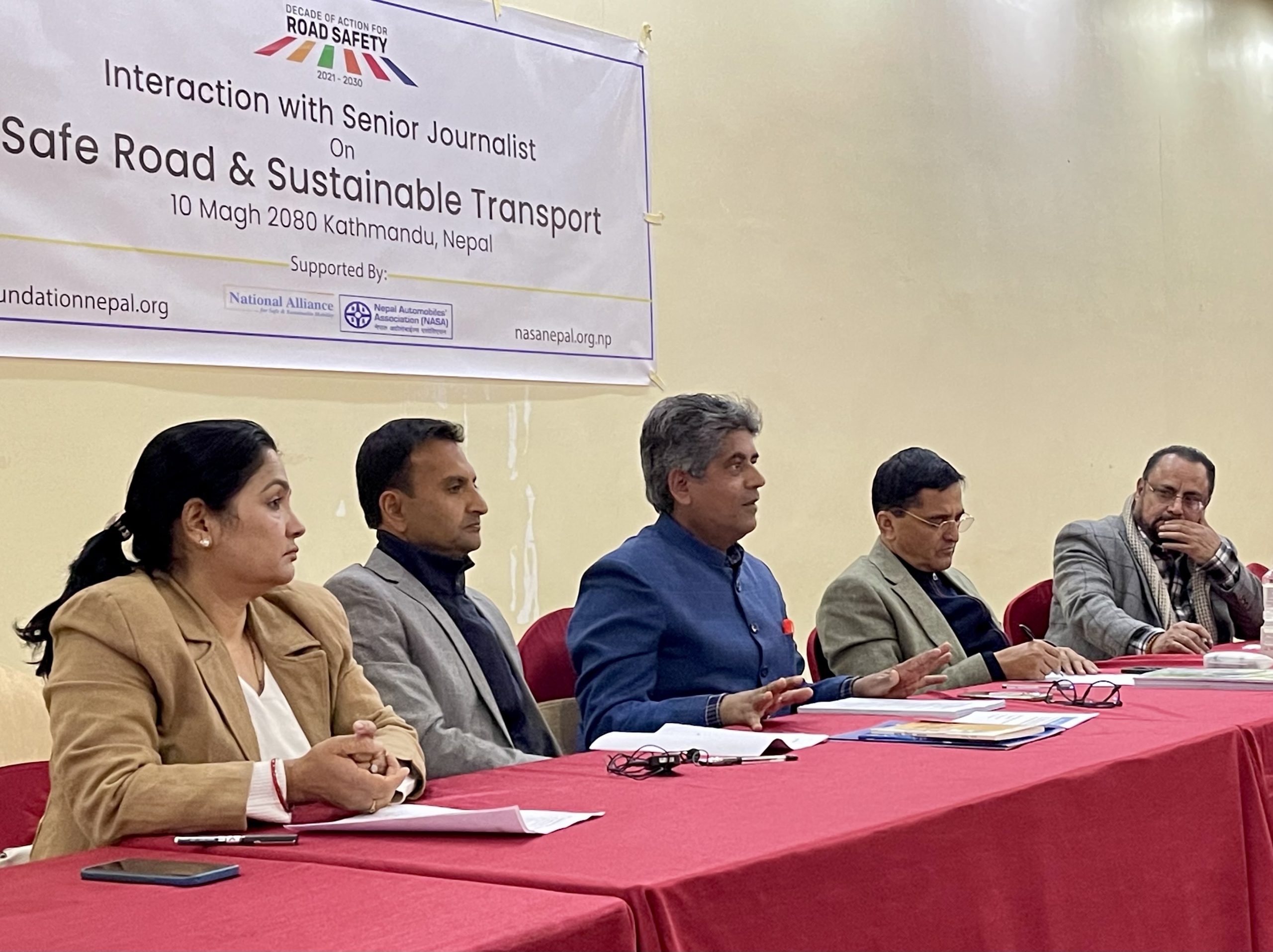
Interaction between sustainable road transportation and safe roads.
Five pillers, Five opinions:
“Sustainable Roads, Safe Journeys: Uniting Voices for a Safer Tomorrow”
On Wednesday, a conversation session about safe roads and sustainable transportation was completed. On this occasion, speakers from the five pillars of road safety (Building Road Safety Management, Safer Road and Mobility, Developing Safer Vehicle, Behavior for Safe Road Users, and Improving Post Crash Response), including Honorable Yogesh Bhattarai, presented their perspectives.
Five presenters discussed the five pillars and the current situation in Nepal. Mr. Yogesh Bhattarai, Mr. Ashish Gajurel, Mr. Govind Bhattarai, Mrs. Bhagwati Sedhai, and Dr. Buland Thapa all delivered statements about the situation in Nepal and road transport. ‘The Road Safety Council with authority and infrastructure is the foundation of sustainable roads and safe driving.. Yogesh Bhattarai (Representative Assembly Member and Coordinator of Alliance for Safe and Sustainable Mobility Nepal)
We have long advocated for the formation of a Road Safety Council. However, no effort has been completed in that direction. A strong road safety council should be established, and specialists from the independent sector should be nominated to it. This is necessary for effective work. Currently, all government entities are responsible for maintaining road safety audit and inspection bodies. It has not brought about fairness in the workplace.
The number of road accidents has recently increased. In this case, the government has not taken ownership of former secretary Sharad Chandra Paudel’s findings and has constituted another investigating task group. If existing laws and regulations are not strictly enforced, the likelihood of accidents increases. Nepal is not represented on the UN’s road safety legislative committee. It is vital to plan for collaboration with international organizations such as WHO, UNICEF, World Bank, ADB, JICA, GTZ, UNDP, BIMSTEC, and SAARC.
Because none of Nepal’s roads were designed with road safety in mind, the right of the common people to exist has been violated in the name of transportation. When there is a single entity in charge of issuing licenses, building roads, and investigating accidents, the true facts of the accident will remain hidden. The majority of traffic accidents that occur nowadays are caused solely by the driver. This is a completely incorrect topic. Unsafe roads in Nepal have been the leading cause of traffic accidents. To cover up its failures, the government often blames the motorist.
Nepal’s government lacks both official and scientific data on traffic accidents. The traffic office reports that 3000 citizens die in Sabari accidents each year. On the other hand, the World Health Organization reports that 8000 civilians die in accidents in Nepal each year. Furthermore, no one knows how many people die after a few weeks or months from minor injuries sustained in an accident. The government must focus not just on building and extending highways, but also on making the roads that are currently under construction safer. Every year, the government incurs a financial loss of 3% of its GDP as a result of road accidents.
“Road safety audit and improvement in public transport is the first condition to reduce human, economic and material losses”
Er. Ashish Gajurel – Transport and Traffic Engineer
Nepal has not been able to construct the required amount of high-quality transportation infrastructure. The road network is being considered for expansion by the government. However, it hasn’t been able to keep up the quality required for its use to be efficient. Local and central roads are not of the same caliber. However, uniformity in safety standards is crucial. Safety regulations don’t matter to anybody. Without a road safety audit, no road is safe. The road has been built in the same manner as intended. Accidents are rising as a result of unsafe roads. Consequently, it is essential to ascertain the minimum requirements for road safety while constructing new roads and to design them appropriately.
The route won’t be constructed just for cars. Zebra crossings, bike lanes, pedestrian lanes, and other features ought to be built in addition to this. However, such matters have received little attention. It should also be decided what safety requirements are required. When and for what number of years will this standard be decided upon? It’s important to keep that in mind. Roads that are not constructed in accordance with norms must be closed.
Additionally, the largest issue is public transportation, which requires improvement. The engineering of bus parks, stops, and lanes can all be modified in a number of ways to address this. The city permits bus routes to be organized based on color. Additionally, buses are available from the settlement’s center. BRT stands for Bus Rapid Transport. It is necessary to set up electric automobiles, charging stations, etc. By giving these things the attention they deserve, public transportation can be made better.
“IDP, Autoland, Star Rated Road, Cars, Schools, and our Safety Helmet Campaign”
Mr. Govind Bhattarai (Council Member, International Automobile Federation – FIA)
In the current context, autoland has become a necessary in many regions. If this is the case, young, educated people will have work prospects. We introduce contemporary instruments and apparatus. Additionally, the city is secure. Up until the government makes significant investments in driving schools, driving standards won’t improve. It is not essential to focus on the process of obtaining the license or the organization that will accept it. However, the driving education system must be created for the purpose of ensuring license quality. A license ought to be given in accordance with the curriculum, instructional strategy, infrastructure, trainer, etc.
It is essential to begin the process of obtaining an International Driving Permit (IDP) from Nepal and to make the Nepali license universal. As a result, the Nepali license is positively viewed globally. Road and transportation research centers do not exist. NAST must address the issue of emissions. A ridiculous argument is made for removing vehicles that are 20 years old. But is that a 20-year-old automobile or a safe car? It needs to be discussed. The worldwide NCAP safety standard should serve as the foundation for this. German and Japanese autos have 40- or 50-year lifespans. Nepal should not be turned into a car junkyard for old cars because of this. Vehicle life and pollution are two distinct things.
In a number of cities, including Kathmandu, speed management is an important consideration. The same distance now takes a different amount of time. To eliminate traffic in Kathmandu, we need to accelerate, but we also need to control it. Nepal has a larger road network than Denmark. There are four times as many cars, though. There’s also something to be learned from this. Nepal has enough highways to accommodate almost two million cars. But that should guide urban planning, population movement, and migration policies. And additional infrastructure.
A car with a star rating needs to be scheduled. The United Nations Road Safety Strategy 2018, the UN Vehicle Regulation Agreement 1958, the UN Convention on Road Traffic 1949, the UN Convention 1968 Vienna (IDP), the UN Convention on Minimum Requirements for the Issue and Validity of Diving Permits 1975, and others. It is imperative that implementation be given careful consideration.
“Civil rights, consumer rights, and health rights are violated by road accidents.”
Mrs. Bhagwati Sedhai – PhD scholar and expert advisor on road safety, NASA Foundation Nepal
In Nepal, traffic accidents are now the leading cause of death among young people. Data from the World Health Organization indicates that 8,479 people died in traffic accidents in 2021. In Nepal, this rate has risen by 75% from 2013 levels, whereas globally, it has fallen by 5%. This further demonstrates Nepal’s lack of activity in this area. 108 nations worldwide have currently cut the number of deaths in this manner by 2 to 50%. But traffic accidents have violated even the most fundamental right to life in Nepal.
The task force Narayankaji Shrestha, the then-Minister of Physical Planning and Transport, established on January 11, 2079, to offer answers to issues facing the transportation industry, has already turned in its report to the Department of Transport Management.
Twelve distinct regulation aim to reduce road accident fatalities by half by 2030. To make sure that such bases are followed, the government needs to take action. Road users need to be mindful of this as well. Creating a national plan for road safety, constructing roads in accordance with safety regulations, owning secure vehicles, lowering the speed limit on the road to half of the current one, and ensuring that even half of the riders on motorcycles wear helmets and seat belts Road accidents can be decreased by halving the number of vehicles on the road, prohibiting cell phone use, and offering enough medical attention and rescue even in the event of an accident.
“Government careless in proper rescue, treatment and rehabilitation of accident victims”
Prof. Dr. Buland Thapa – Senior Vice President Nepal Automobiles Association (NASA Nepal)
The number of fatal traffic accidents is rising. However, there is also a severe issue with accident victims passing away without medical attention. However, very few people are aware of the information on this side. Setting up a cutting-edge ambulance surveillance system is required for this. The accident scene should be the location of first aid. It is also vital to provide the technical personnel required for prompt action.
Make plans so that you can be rescued in less than 30 minutes in case of an emergency. Helicopter emergency response, community education, and training for ward offices, Lions, Red Cross, and other organizations in high-risk areas are also necessary for this.
It should be scheduled to be finished in an emergency-equipped hospital in less than an hour. These days, a lot of people pass away following an accident and arrive at the hospital. It is imperative to establish an environment in which treatment takes precedence above the supply of bail, insurance, emergency funds, etc., even after one has arrived at the hospital. Before the case, the cops ought to be driven to provide aid.
It is also necessary to plan the post-treatment follow-up mechanism. This requires making the required arrangements for work, medication, etc. Health insurance must pay for the procedure. A system that provides travel and passenger insurance to all participants is preferable. Even after the accident, many lives can be spared if we pay attention to these items.
An early announcement of the Road Safety Action Plan 2013-2020 came from the UN. However, there was not much important work done in Nepal during this time. Not much has been done as of yet, not even in the framework of the 2020–2030 road safety decade.
But if more research is done in this field in the future, it will contribute to a decrease in traffic accidents. The Road Safety Council Act has not yet been passed into law. The nation’s labor-intensive National Action Plan is now a historical document. There is no longer a Public Transport Authority. The management of transportation has gotten worse. If everyone works together in this situation, there’s no doubt that some progress will be made in lowering the number of accidents in the future. It is imperative that everyone take note of this.
You can watch the highlights down below (Video Credit goes to Kendrabindu Highlights)